Thursday, October 29, 2020

Blue Vinyl and Environmental Justice and Racism, Continued

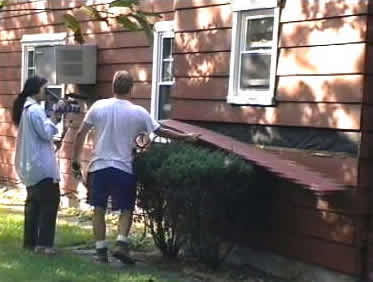
Billy Baggett, attorney for the victims of Lake Charles PVC exposure, prepares to enter the factory with his now patented 360 degree camera platform.

 The first level of environmental injustice occurs at her parents’ house when the siding installer removing the rotting wood tells Helfand that vinyl will only emit dioxins and other toxic chemicals if burned in a fire. Later we learn at least one of these fires prompted the vinyl companies to form a vinyl organization “to protect and promote vinyl” or, according to Helfand and Gold, for damage control after fires in the 1970s and 80s culminated in a huge conflagration at the MGM Grand Hotel where smoke and toxic fumes fed by PVC piping, wallpaper, and plastic mirrors contributed to the majority of the 87 fatalities and 700 injuries. Greenpeace calls PVC the poison plastic because it causes permanent respiratory disease when burned, producing dioxins so powerful that people die from inhaling its gases before the flames reach them.

Dan Ross, a victim of PVC exposure as an employee in the Lake Charles facility, struggles for his life.

Although the toxicity of the contents of Helfand’s parents’ vinyl siding is an everyday ecodisaster, the production process for the PVC vinyl contains highlights a second level of environmental injustice and a second set of victims: those who work in and live in proximity to PVC plants. To uncover the truth about vinyl, the now detective Helfand goes to the source of vinyl siding—St. Charles, Louisiana, where PVC, the main ingredient in the vinyl, is produced in enormous chemical plants that dominate Mardis Gras celebrants, recreational lakes, and fields where cattle graze. Near the factory, the owner of a local restaurant, the Pitt Grill, and workers talk about what causes cancer. It’s the smoke in the air, they explain, broaching at least one violation of environmental justice and human rights. Their environment is clearly not “secure, healthy, and ecologically sound.” But the plant managers argue that hazards near PVC plants may be a relatively good thing because the company takes care of toxic spills fast.

This photographic evidence reveals the industry’s attempt to cover up its knowledge of the dangers of PVC exposure.


As evidence of the blatant environmental injustices caused by the plant, however, several area residents note the repercussions of living near this toxic plant. In the town of Mossville, for example, African American resident Dianne Prince has cancer and believes she received it from the factory.  She asks, is safety a big issue in Lake Charles? At Community Risk Management meetings, other residents discuss the hazards of raw materials from the factories. Residents near the factory are unable to breathe. Trees are brown on the side facing the plant, green on the other. But factory owners only refer Helfand to the Vinyl Institute website where scrolling graphics extoll the uses of vinyl and its “green” recyclable footprint. Vinyl is everywhere, “making a difference every day,” according to the website. And at a conference devoted to alternatives to PVC, the Vinyl Institute was there to exalt the benefits of their product.  Other evidence Helfand uncovers tells a different story:

“They say they’re not hurting the environment, but 56% of the product is chlorine. Is there any proof that it’s safe?“

In this shot, Helfand carries her ever-present example vinyl siding while moving through the canals of Venice, Italy. Here she and Gold document the culpability of the European PVC producers in a worldwide cover-up of the hazards of dioxins in vinyl.


Thursday, October 22, 2020

Blue Vinyl and Environmental Justice Part I

 Blue Vinyl and environmental justice


Blue Vinyl highlights environmental justice and racism issues associated with both production of housing materials and the housing industry. Helfand introduces these issues by documenting the environmental effects of home construction after talking with her parents about new siding for their home. Their red wood is rotten and must be replaced. Helfand’s mother thinks her daughter overreacts to the family’s choice to replace their old wood siding with vinyl. But because Helfand had a rare form of cervical cancer caused by the DES her mother was given during pregnancy, worries about toxic chemicals used in vinyl’s PVC production are a priority for her now. Helfand’s poignant documentary and video diary, A Healthy Baby Girl (1997) illustrates the sense of loss she encountered after the cancer forced her to undergo a radical hysterectomy.  In her exploration of the ecology of home building, Helfand wonders, then, is vinyl siding safe? Blue Vinyl documents the years of detective work Helfand and her co-director Gold perform to discover and reveal their answers.


The film has been both heralded and slammed, primarily because of its rhetorical strategies. It won numerous awards and received laudable reviews  from many reviewers.[2] Other reviewers, however, highlighted weaknesses. For example, The City Paper suggests the film’s narrative may be “manufactured” or “at least jury-rigged.” Reviewer Christopher Null describes it as “extremely long,” and Bill Durodie of the conservative website “Culture Wars” calls Blue Vinyl “a case study in dumbing down.” For us, however, even though Helfand and Gold’s documentary journey to reveal the dangers of PVC production and use may be diluted by Helfand’s choice to personalize the issue in relation to her parents’ siding and her own health issues, it effectively illustrates and addresses environmental injustices of home construction.


Blue Vinyl effectively documents the disastrous consequences faced by residents and workers denied environmental justice. According to the EPA,

“Environmental justice ensures that no population, especially the elderly and children, are forced to shoulder a disproportionate burden of the negative human health and environmental impacts of pollution or other environmental hazard.”

Environmental justice breaks down into three distinctive categories: procedural inequity, geographical inequity, and social inequity. These categories serve as the basis for the UN Draft Principles on Human Rights and the Environment, which state:

    1. “Human rights, an ecologically sound environment, sustainable development and peace are interdependent and indivisible.
    2. All persons have the right to a secure, healthy and ecologically sound environment. The right and other human rights, including civil, cultural, economic, political, and social rights, are universal, interdependent and indivisible.
    3. All persons shall be free from any form of discrimination in regard to actions and decisions that affect the environment.” (Cifuentes and Frumkin 1-2)


By integrating interview data into a personal journey from a Long Island home to the source of its vinyl siding, Lake Charles, Louisiana, the film successfully illustrates the dangerous ramifications to the health and welfare of residents and workers when denied an ecologically sound and healthy environment and forced to endure environmental discrimination and the environmental racism associated with it.

The Ecology of Home in Blue Vinyl and Libby, Montana Introduction

 home in Blue Vinyl and Libby, Montana

by Robin L. Murray and Joseph Heumann

Helfand films the removal of rotten wood siding from her family home. The shot establishes her presence as a character in the film.The Blue Vinyl title shows us the completion of the new siding.

Although many documentaries explore the devastating sense of loss residents feel when their homes are lost or destroyed by everyday eco-disasters, few examine the environmental consequences of the building materials used to construct the home. Blue Vinyl (2002) and Libby, Montana (2004) move beyond lamenting eco-driven loss of the home place found in environmental documentaries from mountaintop removal films such as B. J. Gudmundsson’s Rise Up! West Virginia (2007) and Mountain Mourning (2008)[1] [open endnotes in new window] to Josh Fox’s anti-fracking expose, Gasland (2010), and unmask some of the environmental hazards of the home itself. Although their documentary approaches differ, both Blue Vinyl and Libby, Montana reveal the toxic environmental hazards faced by workers constructing housing materials and the homeowners themselves, with Blue Vinyl focusing on the dangers of Polyvinyl Chloride, and Libby, Montana highlighting asbestos and its mineral source, vermiculite.

In the personal narrative-driven Blue Vinyl: The World’s First Toxic Comedy (2002), co-director and writer Judith Helfand and co-director/cinematographer Daniel B. Gold become comic detectives in their attempt to find a viable solution to Helfand’s parents’ home repair dilemma:  Is it possible to replace rotting wood siding with “products that never hurt anyone at any point in their life cycle” but still provide the economy, endurance, and good looks of cheap but toxic blue vinyl? After attempting to convince her parents to forego their new vinyl siding choice for a more environmentally friendly alternative (as long as it’s cheap and looks good), Helfand and Gold embark on an investigative journey that reveals both the dangers underpinning vinyl use and the challenge to find a viable, affordable, and environmentally friendly alternative.

In Libby, Montana, directors Drury Gunn Carr and Doug Hawes-Davis take a more traditional documentary approach to expose the health hazards asbestos has caused in Libby’s mines and factories from 1919 until their closure in 1990. Also structured like a mystery, this social documentary combines talking head and direct cinema approaches to illuminate the biggest case of community-wide exposure to a toxic substance in U.S. history, resulting at last count in an estimated 1,500 cases of lung abnormalities. The film carefully documents the history of a town that moved from logging to mining vermiculite. Ninety-two percent of  people who worked for the mine more than twenty years died from lung disease. Most condemning is evidence that W. R. Grace & Company knew the danger of asbestos and did nothing. According to the film, despite overwhelming health problems and clear signs of criminal negligence, the EPA’s arrival in 1999 leads only to more wrangling, this time over whether or not Libby should be labeled a Superfund site.

Blue Vinyl provides a narrative of discovery in which Helfand and Gold reveal what the dangers PVC mean for not only her parents and other suburbanites keen on siding their homes with vinyl, but also for PVC chemical plant workers and home dwellers nearby.  Libby, Montana documents a mystery now solved but unresolved due to bureaucratic battles by EPA officials and corporate leaders over designating the town a Superfund site. In these eco-documentaries, multiple issues of home and homelessness are explored, revealing a plethora of environmental problems that, according to Blue Vinyl and Libby, Montana,  especially, should be addressed no matter how difficult the task. The repercussions of doing nothing are too toxic for both human and nonhuman nature. Overlooking these eco-disasters may turn the everyday into catastrophe, these films assert, reinforcing the power of an environmental justice movement grounded in an equitable and humane vision of home.

Although the documentary strategies applied in Blue Vinyl are more compelling than those in Libby, Montana these films both effectively illustrate the complexity of environmental justice issues. Environmental injustice, lack of human rights, and, to a certain extent, environmental racism intersect in the literal study of homes in Blue Vinyl and Libby, Montana. For these films’ directors, it’s not just how you live and how you build your home, it’s where you live and what’s around you that contribute to the everyday eco-disasters associated with constructing and sustaining shelter.  


Sunday, September 20, 2020

Looper Caterpillars, RoboCop, and Eysium


Animal body modification bring to mind the action movie RoboCop (1987) and its 2014 remake, Neill Blomkamp’s Elysium (2013) shows some of the positive outcomes of body modification that line up with those used by the looper caterpillar: self-defense. Max (Matt Damon) is fused with a robotic exoskeleton to defend himself rather than disguise his body, but the purpose behind his choice are similar. Using one character’s plight in a post-apocalyptic future, the film condemns huge disparities between rich and poor and the environmental and social problems they promote. 


As in Blomkamp’s District 9 (2009), Earth has become an environmental disaster plagued by overpopulation and the crime and starvation it produces. Only the rich can escape the polluted planet by purchasing access to an orbiting space station with forests, green lawns, golf courses, and oversized homes—shown in glorious CGI. And only a human machine can bridge the gap between rich and poor they enforce. 


Despite the film’s failure to address environmental racism and justice issues on Earth, Elysium provides an optimistic view of technology and the cyborg as a solution to at least some of the externalities human overconsumption has created. Although Elysium does not address the environmental degradation on Earth’s surface, we assume the robots that once controlled humans will now clean up their waste. 


Although the film's plot-line is confusing, Elysium demonstrates how humans (especially men) may benefit from merging with technology. By donning a mechanical exoskeleton, Max saves those he loves, freeing Earth’s poor in the process. Like the looper caterpillar’s added flowers, an external body modification helps Max thwart a despotic government. He may not survive, but his friends will.


Animal and Insect Body Modification


Although focused primarily on separating humans from nonhuman nature, Etcoff also notes that at least one animal “exhibits a form of dressing” (6): the bowerbird which builds and decorates a bower to attract a mate. Etcoff’s admission in some ways contradicts her assertion that the adornments of dress are uniquely human. It also broaches questions that may connect our evolutionary paths more explicitly to those of the animal world: Are there other species of animals that use ornaments outside their bodies for decoration or disguise? And do these examples begin to redefine our own connections to the natural world and evolution? Do they also reshape the purpose behind the changes we make to our bodies and selves? 


For us, the body modifications explored in American Mary do not separate humans from nature. They demonstrate all too well our connections to it. The multiple species of the male bowerbird, for example, build bowers consisting “of a thatched twig tunnel forming an avenue” decorated with bones, shells, berries, nuts, and stones the male displays to potential mates. They arrange the objects in regular patterns, creating an illusion that seems to increase their size, according to biologists Laura Kelley and John Endler. The bowers are works of art meant only for seducing female bowerbirds, not for nesting and clearly require objects external to the birds to build them. David Attenborough’s documentary, Bowerbirds: The Art of Seduction (2012) highlights the behaviors of multiple species of bowerbirds and demonstrates how deliberately the birds place their artifacts. In one scene, for example, Attenborough moves objects, and a male bowerbird immediately replaces it. 

 Other animals decorate their bodies rather than create external bowers. Sandhill Cranes preen their feathers with mud, turning their gray bodies red or brown during spring and summer. The purpose behind the preening may be related to breeding because it ends when the feathers molt in the fall. And the looper caterpillar ornaments its body with plant parts from the flowers on which it is feeding. According to Dr. Miklos Treiber, the loopers change the flower parts when they move to another flower, as well. Here the plant pieces act as camouflage. Dr. Treibe hypothesized that the looper’s ability to change disguises allows it to have a much more varied diet than some other caterpillars because it isn’t restricted to eating only those flowers or plant parts that it resembles in appearance. Multiple videos document the looper’s amazing camouflage.

Friday, September 18, 2020

Body Modification and the Documentary Modify

What is Body Modification?


Anthropologists explore body modification in relation to a variety of cultural practices. In “Enhancement Technologies and the Body” Linda Hole asserts, “Humans have always modified their bodies. What distinguishes these techniques is that bodies and selves become the objects of improvement work, unlike previous efforts in modernity to achieve progress through social and political institutions” (695). Steven W. Gangestad and Glenn J. Scheyd’s “The Evolution of Human Physical Attraction” explores the question, “can human standards of physical attractiveness be understood through the lens of evolutionary biology?” (523). And Rosemary A. Joyce examines the body as a “site of embodied agency” (139) that changes in response to individual and cultural experiences rather than remaining static. 

Anthropologist and museum curator Enid Schildkrout suggests that body art and the body modification it involves is universal. In fact, “There is no culture in which people do not, or did not, paint, pierce, tattoo, reshape, or simply adorn their bodies.” According to Shildkrout, “Body art communicates a person’s status in society; displays accomplishments; and encodes memories, desires, and life histories.” Body modification may be ephemeral, as with body painting, makeup and hairstyles. But it may also include more permanent changes, such as body shaping, scarification, tattooing, and piercing. Directed by Jason Gary and Greg Jacobson, the 2005 documentary Modify reinforces Shildkrout’s definition with images of the varied forms of modification and testimony from those who personally modify their bodies and the artists and surgeons who modify them. The documentary asserts that there are four reasons for body modification: aesthetics, sexual augmentation, shock value, and spirituality. For most of the experts documented in Modify, body modification is body art and includes hair color, ear piercing, and body building, as well as tattooing, body piercing, and plastic surgery.

Close Reading Film Genre

                                                                                                                            trailer


  1. What kind of movies or TV shows are these?
  2. How do you know?
  3. What elements separate films of this sub-genre from other
types of films or media? Other horror films or media?

4. What do these films or media tell you about the qualities
of this sub-genre?

5. How do you account for the differences among these
film/media?

6. How well received would a film be if it deviated too greatly
from your expectations for that sub-genre? For example,
how would audience members react if they went to a
movie billed as a comedy, and the film did not have a
happy ending?

7. How important are audience expectations? How much
should writers consider their audience(s), when they are
beginning to write?

8. How does knowing a text’s genre help you as a reader?
  • First think of a favorite movie and consider where you
might find it on Netflix or other streaming service, if it were
not a new release:
It could be categorized as a comedy, a romantic comedy, an
action/adventure film, a drama, a horror film, or a
science fiction/fantasy film. It might also be an
animated film/children's film, a documentary, or a
classic or a foreign film, etc.
  • Once you determine the category heading under which the
movie would be placed in the store, you can get together with
peers who have favorite films in the same category and begin
analyzing the characteristics films in your category share—
plus ones that seem unique to your particular film.

  • In groups arranged by genre, or movie category, answer
questions like the following to outline the characteristics of your
movie's genre:
  • What is the setting (time and place) of the film like?
  • What is the plot like? Is there a happy ending? Is there an indication that a sequel might be possible? Are there recurring storylines?
  • What are the characters like? Are there stock characters? If so, what are they like? Are the characters well developed? Or is the movie more driven by the plot or story?
  • What kind of special effects are there in the movie? What purpose do they serve?
  • How does the cinematography contribute to the film & its content?


Murray/Heumann Ecocinema Research (Book Publications): Ecocinema and Media Website