Saturday, April 12, 2014

Film and Everyday Eco-Disasters: Releasing in June!


Film and Everyday Eco-disasters

Available in June 2014
University of Nebraska Press

 Robin L. Murray and Joseph K. Heumann

Eco-disasters such as coal-mining accidents, oil spills, and food-borne diseases appear regularly in the news, making them seem nearly commonplace. These ecological crises
highlight the continual tensions between human needs and the environmental impact these needs produce. Contemporary documentaries and feature films explore environmental-
human conflicts by depicting the consequences of our overconsumption and dependence on nonrenewable energy.

Film and Everyday Eco-disasters examines changing perspectives toward everyday eco-disasters as reflected in the work of filmmakers from the silent era forward, with
an emphasis on recent films such as Dead Ahead, an hbo dramatization of the Exxon
Valdez disaster; Total Recall, a science fiction action film highlighting oxygen as a
commodity; The Devil Wears Prada, a comment on the fashion industry; and Food,
Inc., a documentary interrogation of the food industry. The authors evaluate not only
the success of these films as rhetorical arguments but also their rhetorical strategies.
This interdisciplinary approach to film studies fuses cultural, economic, and literary
critiques in articulating an approach to ecology that points to sustainable development
as an alternative to resource exploitations and their associated everyday eco-disasters.

Robin L. Murray is a professor of English at Eastern Illinois University.
Joseph K. Heumann is a professor emeritus of communication studies at Eastern
Illinois University. Murray and Heumann are the coauthors of Ecology and Popular
Film: Cinema on the Edge; That’s All Folks: Ecocritical Readings of American Animated
Features (Nebraska, 2011); and Gunfight at the Eco-Corral: Western Cinema and the
Environment.


Saturday, April 5, 2014

The Limits of Elysium (2013)


Neill Blomkamp’s Elysium (2013) shows some of the positive outcomes of body modification when a human named Max (Matt Damon) is fused with a robotic exoskeleton. Using one character’s plight in a post-apocalyptic future, the film condemns huge disparities between rich and poor and the environmental and social problems they promote. As in Blomkamp’s District 9 (2009), Earth has become an environmental disaster plagued by overpopulation and the crime and starvation it produces. Only the rich can escape the polluted planet by purchasing access to an orbiting space station with forests, green lawns, golf courses, and oversized homes—shown in glorious CGI. And only a human machine can bridge the gap between rich and poor they enforce. Despite the film’s failure to address environmental racism and justice issues on Earth, Elysium provides an optimistic view of technology and the cyborg as a solution to at least some of the externalities human overconsumption has created.


As one of the many impoverished children living in an orphanage Max leaves this desecrated Earth with his friend Frey (Alice Braga) only in dreams. After Frey reads him books about extinct animals and the paradise above them in Elysium, Max wants to buy tickets to Elysium for himself and Frey and escape the hell Earth has become. Instead, Max becomes one of the masses still living in the environmental wasteland. As an adult, Max has a shaved head and a muscular and tattooed body. He has not fulfilled his dream. Instead, he is an ex-con on probation for grand theft auto working at a factory where robotic weapons are produced. Since he holds one of the few jobs in the community, however, children surround him and beg for money as he walks toward a bus.


The horrific conditions on Earth are amplified when a robot police officer accosts Max when he jokingly suggests he has committed a crime. Because this is a police state with a zero tolerance policy, the robot breaks one of Max’s arms and extends his probation by eight months. Now late for work, Max’s pay is docked, and his broken arm nearly costs him his job. The incident introduces the characters in the film and provides the impetus for Max’s body modification. At the hospital where his broken arm is cast, Max is reunited with Frey who now works as a doctor. Max seeks a reconnection with Frey, but her daughter Matilda (Emma Tremblay) has leukemia, so she refuses his advances. We are introduced to the world of the rich and its representatives at the factory where Max works. John Carlyle (William Fichtner) runs the factory and engineers software for Elysium where he plans to emigrate soon. Carlyle works for Elysium’s Defense Secretary Delacourt (Jodie Foster). She is a cutthroat opponent to immigration who will do anything to maintain her power, including shooting down a shuttle of illegal immigrants that includes a mother seeking medical help for her sick daughter.


These incidents foreshadow the event that will change the relationship between Earth and Elysium and introduce the useful role body modification can play. The conflicting characters have been introduced, but so has the motivation for their climactic battle: access to Med-Bays that can cure any ailment on Elysium. The Med-Bay becomes a necessity when one of the factory machines malfunctions and Max is forced to enter a radioactive compartment to clear pallets and close a door. The door slams shut before he can escape, and his manager will not allow anyone to open it. After the radiation dissipates, a robot wheels out Max. He is still alive, but has suffered a lethal dose of radiation and has only five days to live. His only hope is a Med-Bay found only on Elysium and accessed only with the help of body modification—a surgically applied armored exoskeleton and a data collecting brain implant.


The plot grows complex after this, but ultimately Max foils Delacourt’s plans to become president, uploads data from Carlyle, and (after multiple battles) downloads data into Elysium’s computer system that makes Earth’s inhabitants citizens of Elysium. The download kills Max, despite his superhuman exoskeleton, but it saves Frey and her daughter Matilda. The download also saves the lives of thousands of Earth inhabitants with medical conditions. In a final scene we see shuttles full of Med-Bays launched to Earth to cure them. Elysium fails to address the environmental degradation on Earth’s surface, but we assume the robots that once controlled humans will now clean up their waste. Despite the film’s confusing plotline, it demonstrates how humans may benefit from merging with technology. By donning a mechanical exoskeleton, Max saves those he loves, freeing Earth’s poor in the process.

Is Fracking Ethical? : Ask The Ethics of Fracking (2014)

Is Fracking Ethical?


Fracking has become an energy extraction success story in the United States in the past decade. Exploitation of natural gas and oil deposits has increased dramatically, thanks to the process of fracking, and many politicians and energy boosters now claim that the US will soon be "energy independent" and thus immune to outside pressures from OPEC and other energy monopolies.The Russian invasion of Crimea has been met with demands to export natural gas that is supposedly in large supply to European nations that are dependent on Russian natural gas deliveries.


But is fracking really a success story? Is it really the greatest means of developing carbon based energy? Are there "externalities" that have to be considered? Is this process moral and ethical? Will we be paying far too great a cost for such short term gains? Green Planet Films' The Ethics of Fracking(2014), takes on these issues, and does so in an activist fashion that eschews the false dichotomy of "balanced reporting". The film defines the concepts of ethics and morality and does so by interviewing 6 individuals who all have serious disagreements with the supposed benefits that this new energy extraction system promises.


And it isn't as if the energy industry hasn't started to admit in a variety of ways the destructive nature of this process. It just does so in an oblique fashion. Three quick examples will illuminate the energy industry's new concern with the potential destructive effects of fracking. The first was the response of Exxon/Mobil's CEO, Rex Tillerson, to the building of an enormous water tower near his Texas mansion hideaway. Tillerson threatened to go to court to stop the tower's construction, complaining that it would destroy both the value of his property and the peace and comfort of his homestead. Water towers attract trucks, in large numbers, to collect million of gallons of water to be delivered to well sites, 24 hours a day, 7 days a week. It might be good for the citizens of Ohio, to watch their home lives disrupted by broken roads, noise, dust and endless lines of trucks. But it wouldn't do for the man who both touts the success of fracking and the price we must all pay for cheap energy.


The second also comes from Exxon/Mobil, who, according to an April 5th article in the Wall Street Journal, written by Daniel Gilbert, "agreed to publicly disclose more details on the risks of hydraulic fracturing of oil and gas wells, reversing a long-held opposition after negotiations with environmental groups and investors." It appears that 50% of Americans now oppose fracking and major energy companies are now faced with having to reveal the nature of their drilling processes if they don't want to lose a major source of income production in the coming years. Stay tuned till September for any information to be revealed.
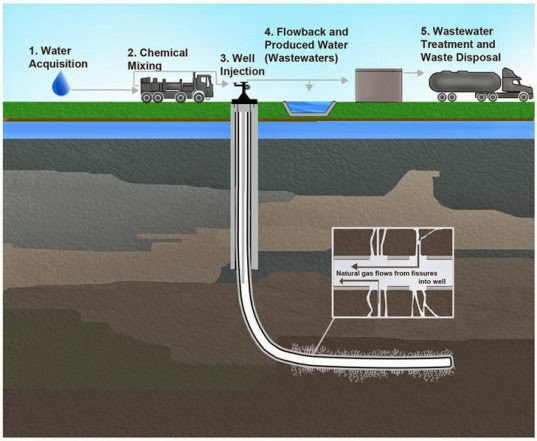


The third sample comes from an excerpted section(WSJ's April 6th issue)  from Russell Gold's upcoming work on the fracking industry, "The Boom:How Fracking Ignited The American Energy Revolution and Changed the World." Gold, who is one of the Wall Street Journal's energy industry reporters, is willing to concede that safe practices have not been of concern to the industry in their headlong pursuit of production. He outlines three areas of concern that he feels should be mitigated, thus admitting to the destructive practices that have been going on without any concern to people or the environment. Gold points out that destruction of air, water and the health of the populace could easily be changed if appropriate industrial practices were employed. But by exposing these problems, he also admits that they exist, thus supporting the ideas brought forth in The Ethics of Fracking, that these processes have been destructive, unethical and immoral.


This new 36 minute documentary takes  a simple talking heads strategy, accompanied by footage of the enormous destructive presence of trucks, pipelines, drilling stations, pumping stations and other processes that produce and deliver natural gas and oil to refineries all over the country. The six people interviewed include a Pennsylvania congressman (Matt Cartwright), an environmental engineering professor (Dr. Marleen Troy), an MD specializing in Nephrology (Dr. Alfonso Rodriquez), a rabbi, a priest and a philosophy professor. Each individual challenges the energy industries positive spin on the endless benefits of this new production process. They all define their positions with well defined concepts of ethics and morality and ask whether or not the companies responsible for these production processes are doing the same.


Groundwater pollution, methane releases, air pollution, noise and light pollution are all examined for their effects on human and non-human life. Are social, environmental and ecological effects the concern of profit making companies? The six people believe that corporations must be held accountable and lay out evidence for the negative effects of an industrial process that has run wild over the land and the people of affected states that contain enormous shale gas and oil deposits. The film makes legitimate arguments that it's not all blue sky and good times for all who are surrounded by the fracking industry. Compromised water, air, and health standards is not a small price to pay for energy success. It is an enormous cost that will have an impact on the populace well after the extraction process ends and the wells go silent. By asking if this industrial process and can stand ethical and moral challenges, The Ethics of Fracking, expands the arguments that are growing daily across the country about this industrial practice.


Wednesday, April 2, 2014

Central Illinois Feminist Film Festival Winners 2014!


Documentary Film Winners

First Place: White Robes, Saffron Dreams
White Robes, Saffron Dreams. (Thailand/India, Dir. Teena Gill, 2013) (43 minutes) White Robes, Saffron Dreams looks at the discriminatory treatment of women in Theravada Buddhism in Thailand. Through the life of a young monk and a Mae Chi nun the film explores how Buddhist institutions provide a social security network to boys, in a country where a large percent of the population are poor, but fail to give girls access to these facilities. The film interviews the first Thai woman to be ordained a full nun in the Theravada tradition. The film's suggestion that boys become monks not only to procure an education but also to ensure their reincarnation points to an environmental theme found in the film. Because women are excluded from the priesthood in Thailand, they pay alms to monks to "purchase" good Karma. This karmic view also connects with animism and pantheism, since human spirits may inhabit animals when reincarnated.
Second Place: Lesbiana: A Parallel Revolution
Lesbiana: A Parallel Revolution. (Canada, Dir. Myriam Fougere, 2012). (63 minutes)Growing out of the civil rights and feminist upheavals of the 60s, the lesbian-feminist movement caught fire in the 1970s, with a flowering of bookstores, communes, philosophical theory, political debate, music, sexual experimentation, performance, witch craft and more. Director Myriam Fougère tracks down the women at the forefront of the movement, now vibrant elders, who discuss hot-button issues such as separatism and the different experiences of white lesbians and lesbians of color.
Honorable Mention: A Word to the Young Ladies
A Word to the Young Ladies. (New Mexico, Dir. M. Catherine Jonet, 2013). (4.37 minutes) The film uses footage from different ephemeral films about puberty directed at young women and a 1942 Superman cartoon to challenge heteronormativity and gender conformity in the social guidance film genre.
EIU Student Award of Merit: Ain’t I a Woman?
Ain’t I a Woman? (U.S. EIU Student, Dir. Breeahnah Babers, 2014) (2.28 minutes). Ain’t I a Woman celebrates the inspirational words of Sojourner Truth. The video is a compilation of footage of a variety of women from Eastern Illinois University reciting parts of Truth’s speech.

Fictional Film Winners

First Place: Substitute Teacher
Substitute Teacher. (Israel, Dir. Shiry Price, 2012) (17 minutes) Ariela, a 34 year old introvert teacher, is pregnant from a man who is no longer part of her life. Entering a new high school class she meets David, a 15 years old student. A tender connection develops between the two and makes Ariela wonder if she has what it takes to become a mother after all.

Second Place: Miss Librarian
Miss Librarian. (Philipines, Dir. Joyce Rochelle Montañano, 2013) (17 minutes). A depressed school librarian named Jeanette is confined between two different worlds -- the four corners of the school's library and the four walls of her house.

Honorable Mention: Make Out
Make Out. (New York, NY, USA, Dir. Geri Ashur, et al., 1970) (5 minutes) Make-Out shows a young couple in a car, “making out” as we hear the young woman’s real thoughts on what is happening and why.