Tuesday, April 19, 2016

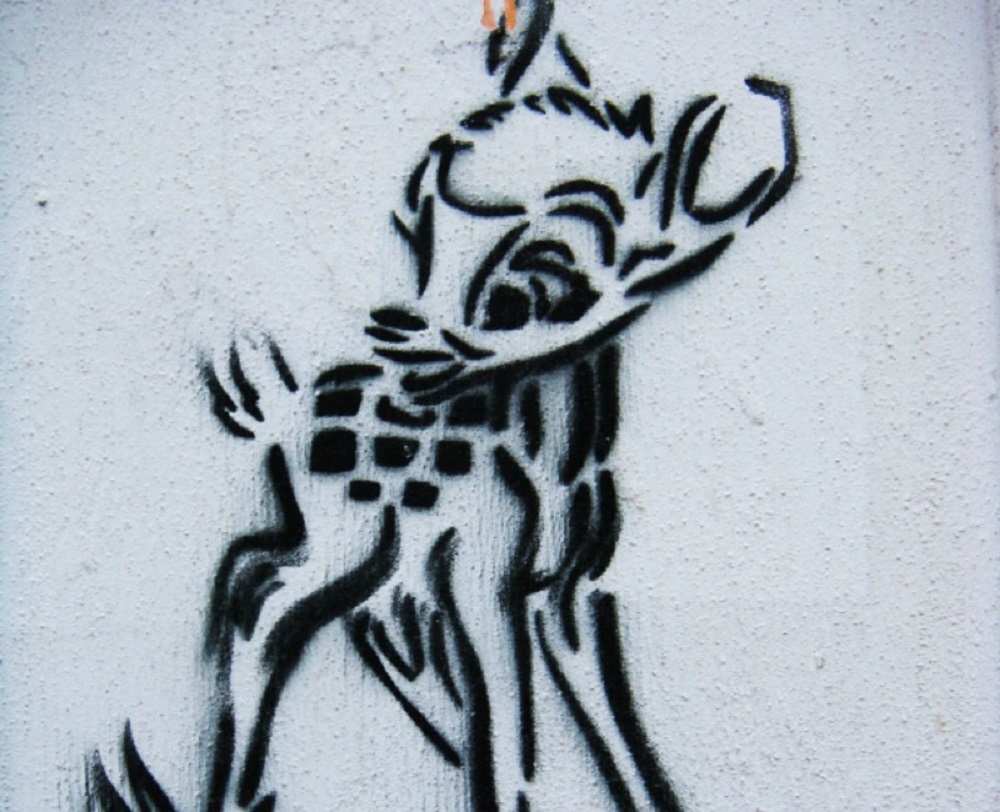
Bambi: The Sentimental Disney Cartoon that Cemented the Myth That Man and Nature Can’t Coexist

 How ‘Bambi’ Hoodwinked American Environmentalists

The Sentimental Disney Cartoon Cemented the Myth That Man and Nature Can’t Coexist
Murray on Bambi LEAD
What It Means to Be American Perking up her ears, the dog was the first to notice them, just a few blocks from our homes in east-central Illinois. One-by-one the does strolled from the woods into the meadow. They eyed us without lifting their tails, seemingly habituated to this neighborhood. Their appearance awed us but also prompted different responses. Joseph recalled long past hunting trips four miles south in a tree stand overlooking a soybean field and tried to pick out the fattest doe in the group. But Robin remembered watching Bambi at a theatre birthday party at the age of six. That brought her, the birthday boy, and the other female guests to tears, wondering if our mothers might be next.


These contradictory responses suggest the lingering strength of the Bambi myth, the lasting legacy of Walt Disney’s 1942 cartoon about that big-eyed fawn. Seventy-four years later, Bambi’s worldview still animates debates over animal rights and environmentalism: Should we save Bambi or save the earth?


Bambi didn’t start as an American environmental fable. Written by an Austrian author with the pen name Felix Salten for adults in 1928, Bambi: A Forest Life, recounts the story of a fawn who grows up to be the prince of the forest alongside his royal father. But his rise to power comes only after the death of his mother and near loss of his mate Faline. While hunters are a problem for these deer, so are animals: In the forest, owls eat mice, crows eat a friendly rabbit, and a fox eats a duck. Early reviewers considered the book an anti-fascist fable and more recent writers have speculated that the story was an allegory about the plight of Jews in Europe. All of Salter’s work was eventually banned in Nazi Germany.


By 1942, when Disney released the film, Americans were processing their shock at the attack on Pearl Harbor and our entrance into a world war, which is reflected in the film’s simplified portrayal of deer living in an idealized forest where predators and prey play together and fear only a shadowy character called “Man,” who is equipped with guns and fire. The emotional punch of Disney’s Bambi is heightened by its artistry, which combines gorgeous natural realism with cartoonish animals, their exceptionally large heads, small noses, and wide eyes resembling human children. Disney gave Bambi playful friends like the rabbit Thumper and the skunk Flower, in contrast to the more melancholy, quarrelsome animals of the book. Even though these cartoon animals frolic to the tune of “Little April Shower,” Disney paid special attention to the details of the forest, sending artists to sketch foliage in Maine’s Baxter State Park and shipping two fawns to the studio as artist’s models. This uncanny mix of cuteness and terror and fantasy and realism has led some to call it a horror film.


When it was released in 1942, Bambi the movie was surprisingly controversial, but not for the same reasons as the book. Hunters in particular saw it as an ideological threat. Outdoor Life editor Raymond J. Brown called the film “the worst insult ever offered in any form to American sportsmen,” and even asked Disney to correct slurs against hunters, according to anthropologist Matthew Cartmill’s A View to a Death in the Morning: Hunting and Nature Through History. Disney claimed sportsmen were not the targets because Salten’s story was about German hunters. In 1988, Field and Stream urged “hunters to start protesting against the “Bambi-killer jokes” they sometimes encountered.


Bambi had fans too. In a July 1942 issue of Audubon Magazine, naturalist Donald Culross Peattie “hotly denies” that Bambi “misrepresented anything.” That same year the National Audubon Society compared the cartoon’s consciousness-raising power for the environment to what Uncle Tom’s Cabin did for the abolition of slavery. New York Times reviewer Theodore Strauss claimed Disney films “teach us variously about having a fundamental respect for nature. Some of them, such as Bambi, inspired conservation awareness and laid the emotional groundwork for environmental activism.”
When it was first released, Bambi lost money, but subsequent re-releases in theatres and video rentals brought in close to $300 million by 1988 as the film became a rite of childhood. And over the years that “emotional groundwork,” took hold in the form of “The Bambi Factor,” a sentimental anthropomorphized view of wildlife, especially deer.


One of the first people bitten by the Bambi Factor was, ironically, early environmentalist Aldo Leopold. In 1943, Leopold encouraged Wisconsin to institute an antlerless deer season that would have allowed hunters to shoot does and young bucks to thin the overpopulated herd. Leopold was interested in the good of all life as part of an ecosystem, not just special animals. In his Sand County Almanac, Leopold extends ethics to include nonhuman animals, as well as the plant life that sustains them. For Leopold, “the individual is a member of a community of interdependent parts,” and those parts include all elements of the natural environment, from soil and plants to “Bambi.” A graduate of the Yale forestry school, Leopold promoted game management, evolutionary biology, and ecology, rather than sentimental anthropomorphism. To maintain a diverse ecology, Leopold supported regulated sport hunting, including shooting a limited number of Wisconsin’s does with the aim of keeping the herd size smaller. But his Wisconsin proposal was shot down—the public, according to scholar Ralph H. Lutts, was outraged at the idea of culling any of Bambi’s child-like creatures.


But there’s another environmental ideology hidden in Bambi that’s at odds with reality. Bambi’s underlying message is that “Man” and deer can’t co-exist. Only Man disrupts the pristine view of nature in the Bambi cartoons. “Why did we all run?” Bambi asks after a gun shot sounds. “Man was in the forest,” his mother replies. A later gunshot is the last we know of Bambi’s mother, hiding the violence that is heightened by her absence. Other hunters go on a chilling rampage, wounding Bambi and causing a final eco-disaster when their campfire explodes into the woods and destroys the animals’ home. The fire effects light the scene in oranges and reds, in the spirit of the “Burning of Atlanta” scene in Gone with the Wind. In the context of Disney’s film version of Bambi, humans and their vicious dogs are shadowy harbingers of death destroying an idealized paradise. Disney focuses almost entirely on a human-free world of the forest. Unless a spectral man appears, animals of all species live without fear in a “paradise” untouched by human hands. Even owls act like vegetarians! In Disney’s natural world, interaction with humans ends only in death or suffering, so the only real choice is a complete separation between the two worlds.


As academics, Bambi’s worldview interested us: Did the “paradise” view of the forest precede the more modern idea of the ecosystem in popular culture? We were surprised to find that it didn’t. Just a few months before Bambi came out, audiences went to see the Fleischer Brothers’ animated feature Mr. Bug Goes to Town (1941). Instead of contrasting conflicts between humans and idyllic nature, Mr. Bug Goes to Town demonstrates how lowland bugs and humans can live interdependently in a human couple’s urban garden in the center of Manhattan. Despite the anthropomorphism on display, Mr. Bug’s focus on interdependence connects with more realistic views about wildlife management and interconnected communities of plants, bugs, animals, and human animals. While Mr. Bug was modeled on sophisticated Hollywood comedies of the time, Bambi reflects Disney’s focus on emotionally convincing yet traditional folktales meant to appeal to broad audiences.


Contrary to the Disney story, of course, deer are all too comfortable with “Man,” “Woman,” and “Cars,” not to mention our delicious gardens, lawns, and infant trees. By 2015, predictably, protests against the Bambi Factor started to come from drivers and organic gardeners as the deer population grew dramatically. The National Traffic Safety Administration estimates that deer cause 1.5 million roadway accidents per year with 150 human fatalities and 10,000 personal injuries, as well as $1 billion in property damage. On Internet gardening forums, gardeners grouse about deer invasions.
Bambi lovers want to protect the deer even when the deer are sick. As recently as 2012, naturalist Valerie Blaine blamed the Bambi Factor for the North Rutland Deer Alliance’s opposition to killing deer even to test for chronic wasting disease. According to Blaine, the group felt any herd reduction would spoil their “deer watching experience” in Chicago’s Northwest suburbs.


The Bambi Factor encourages sentimentalized views of wildlife that romanticize nature without accepting its messier aspects. With its vast and varied ecologies, America’s myth is that it is both a frontier to be conquered and an Eden to be preserved, but there’s more to living on this planet than choosing between paradise and a parking lot. Bambi presents us with a powerful vision that is in a sense a false choice. Instead of looking for a paradise that separates us from wild nature, we need to find a new vision that stresses how to live together, balancing habitat preservation with wildlife management. Bambi is, after all, just a movie.

Tuesday, April 12, 2016

Milk of Sorrow (2009) and the Wedding Portrait


I watched Milk of Sorrow (2009) again tonight as the lab segment of a film class focused on film and the city. My co-writer and I have included it in two of our works now.


In the first, we explored how displacement effects protagonist Fausta--a forced exit from a village home to the seemingly lifeless outskirts of Lima, Peru that is exacerbated by a traumatized and terrorized body.


Our second examination explored how gardens are used in the film--the literal garden of Fausta's European employer, as well as the figurative potato garden growing inside her.


While watching the film tonight, I noticed one more way natural elements are presented in the film--through the backdrop used for photos after a family wedding. In a variety of typical wedding pictures, from the loving couple reenacting the proposal to an extended family posing like a choir, a painted waterfall backdrop enhances the joyous occasion. In the mountain desert that surrounds them, the green and blue matte painting looks like a rain forest oasis.


Only when Fausta enters her employer's walled garden or talks about the one she left behind in her village do we see nonhuman life in Milk of Sorrow. But the backdrop for wedding portraits suggests they yearn for green.

Tuesday, April 5, 2016

English Studies Conference, Eastern Illinois University, April 7-8, 2016


Pre-Conference Events
Thursday April 7 in Witters Conference Room, Booth Library 4440

4:30 – 5:15
We Need Diverse Media!
with Dr. Robin Murray (Coordinator, EIU Film Studies minor)
Come for a lively discussion of diversity in contemporary film.
Stay for a chance to win one of twenty DVDs in the raffle. 


Refreshments will be served between events

5:45 – 6:45
Social Justice Teacher Panel
featuring EIU Alums
Nico Canaday, Mt. Zion Public Schools
Kathy Decker, Champaign Public Schools
Lisa Nuku, Monticello Public Schools


English Studies Conference
Friday April 8, Third floor of Coleman Hall

Presentations, readings, panels, and workshops by EIU students—a celebration of the rich variety of academic, professional, and creative activities in English Studies.

Conference Schedule
9:00     Registration opens
10:00   Sessions
11:00   Sessions
12:00   Free Lunch + Poster Sessions
1:00     Keynote Address by Dr. Melissa Ames (see below)
2:00     Sessions
3:00     Sessions

Keynote
1:00 Friday April 8 in Lumpkin Hall Auditorium

“Funhouse Mirrors: Culture’s Distorted Visions of Gender”
Conference keynote by our own Dr. Melissa Ames, author of How Pop Culture shapes the Stages of a Woman's Life: From Toddlers in Tiaras to Cougars on the Prowl

Wednesday, March 30, 2016

Wong Kar Wai's *Chungking Express* and Urban Environments


Many critics and reviewers have noted how Chungking Express transforms Hong Kong from setting to character, an urban environment that mirrors and promotes the alienation and coping strategies implemented by all four protagonists. Brigette Ling, the Woman in the Blonde wig, wears femme fatale disguise that includes a trench coat, blonde wig and sunglasses. He Zhiwu, Cop 223 (Takeshi Kaneshiro) jogs each time he loses a girlfriend, claiming the sweat eliminates his tears. Faye (Faye Wong) listens to "California Dreaming" at such a high volume that she can't think. And Cop 663 (Tony Chiu Wai Leung) pretends his ex-girlfriend is waiting for him in his apartment, ready to jump out of a wardrobe in her flight attendant uniform. 


Although I certainly agree with these interpretations of how the Hong Kong environment both perpetuates and ameliorates stereotypes of the city as an isolating and alienating ecosystem, for me, food and house pets more effectively connect these human figures with nature and each other. Food, goldfish, and a pet dog illustrate ways an urban environment can promote interdependence rather than separation. 


Food and setting interconnect in Chungking Express through the crucial location in the film: the Midnight Express takeout restaurant. The restaurant provide parallels and points of overlap between the two seemingly disparate romance narrative in the film. Cop 223 frequents the restaurant, using the public phone to call all of his ex-girlfriend's relatives and check his messages. The lack of response to these call leads Cop 223 to the bar where he meets and immediately falls in love with the Woman in the Blonde Wig. Nearly every day, Cop 663 buys food at the restaurant for his girlfriend, moving from a chef salad to other dishes at the owner's suggestion. He even claims she left him because he bought fish and chips and decided she wanted variety in men as well as meals. Faye works at the restaurant to help out her uncle, filling in when an employee leaves suddenly. 


But food also connects characters and the environment in less obvious ways. When his girlfriend May leaves him, Cop 223 buys one can of pineapple slices per day with an expiry date of May 1, explaining, "We split up on April Fool's Day. So I decided to let the joke run for a month. Every day I buy a can of pineapple with a sell-by date of May 1. May loves pineapple, and May 1 is my birthday. If May hasn't changed her mind by the time I've bought thirty cans, then our love will also expire." On the last day, he eats all 30 cans. His voiceover narrates the journey the pineapple took before ending up in the cans, from field to processing plant, to store shelf. This focus on process explicitly connects him to a natural world beyond but integral to the life of Hong Kong. 


 Cop 223 eats voraciously throughout his narrative, not only devouring gallons of pineapple, but also eating four chef salads with french fries and a burger during the night he watches Woman in the Blonde Wig sleep. These American foods tie Cop 223's story with Cop 663's in a couple of ways. First because Cop 663 buys a chef salad every day until convinced to provide variety. Secondly because Chef Salads are associated with California, the "California Dreaming" of Faye's song and the locations where they "meet" in parallel--the California Bar and the actual California. 


Food brings Faye and Cop 663 together, too. Although after changing shifts, Cop 663 eats Cantonese Food at an outdoor stall instead of American takeout, Faye finds him on her trips back from the produce market, easily convincing him to carry her heavy baskets of fresh vegetables back to the restaurant. The film's conclusion at the Midnight Express counter also connects the two, but I've provided way too many spoilers already. I've also run out of time, so I will need to write about the power of house pets in a later post. 


Tuesday, March 22, 2016

Tonight's Central Illinois Feminist Film Festival Screenings


5:00 p.m. Documentary Film Winners

First Place: City’s Step Child and The Dump Hill Dreams (India, dir. Pranab Aich):
Unlike the many rag pickers working at this Dump Hill Land Fill in Delhi, young Devendra is committed to collect electronic waste discarded from our homes, in an attempt to create machines. Even the carcinogenic gases emitting from this hill have not been able to poison his engineering dreams. This 6min documentary takes us through the breading-winning yet melancholic hill made out of city waste and its inhabitants living at the margins of health and poverty. 6 minutes.
Second Place: Why Not be Beautiful. (Brazil, dir. Sabrina Luna):
A sound remix of the TV documentary Why Not Be Beautiful? (1969, Handed Film Corporation) made with appropriated images from vintage stag, burlesque, underground and BDSM movies.
Women are tortured by the voiceover, which suggests how they should behave and look to be successful in life. Now the women are trying to be free of this voice, who commands several females’ lives. 7:13 minutes.
 
Third Place: Portraits of the Historical Maria Zélia Village (Brazil, dir. Patricia Helena dos Santos):
The film reveals the vestiges of the past and present in daily records of Vila Maria Zelia, a working pioneer village of São Paulo. 16:32 minutes.
 Student Film: The Skin I’m In (United States, dir. Rajaiah Jones):
Three black females share their experiences on life, insecurities and what it means to be beautiful. 5:59 minutes. 

5:45 p.m. Fictional Film Winners
First Place: Rainbow Party. (Iceland, dir. Eva Sigurdardottir):
In a tale of twisted innocence, 14-year-old outcast Sofia is offered the chance to join the popular group at school, but doing so requires making serious sacrifices. Whoever said that teenage girls were pure and innocent? 15:58 minutes.
Second Place: The Window. (Israel, dir. Rivkatal Faine):
This film offers a rare female perspective on a powerful inter-generational relationship between two woman—One young and rebellious, the other elderly and lonely. 24:56 minutes.
Third Place: The Position. (Spain, dir. Lidia Ortega Camara):
The film exposes the adventures of a woman when she enters a public bathroom. 11:00 minutes.
Student Films:
The Octopus Lady. (Singapore, dir. Amanda Wang Ziyan): Moving from the sea to the city, The Octopus Lady finds herself literally a fish out of water. Dreaming of a home, she is torn between her desire to fit into the industrious yet impersonal city that she is now trying to make a living in, and returning to the sea. 3:34 minutes.
Canned. (USA, dir. Ivan Joy, Tanya Zaman, Nathaniel Hattan): A street artist paints a beautiful mural of a woman on the wall and is suddenly chased by police for having vandalized. The beautiful creation comes to life to save her creator in a chase scene through the favelas of Rio de Janeiro. 3:03 minutes.
 
Thanks to Women’s Studies, the College of Arts and Humanities, The Coles County Arts Council, and the Central Illinois Feminist Film Festival Committee for helping make this such a successful event!

Wednesday, March 16, 2016

Central Illinois Feminist Film Festival Screenings on March 22!


Central Illinois Feminist Film Festival
      
Eastern Illinois University

March 22, 2016

We will be screening the top 3 winning short films and top student films in fictional and documentary categories. All films are of high artistic quality and satisfy at least two of the following criteria:
  • Films created with an emphasis on gender and/or social justice issues
  •     Films that link local and global issues
  •     Films created by people underrepresented in the media field (women, people of color, queer /transgendered people, people with disabilities)
  •     Films made by people from the Central Illinois area

    2015 Documentary Film Winner


    This film festival promotes the mission of our Women’s Studies Program: to promote an understanding of how issues related to gender, age, race, economic status, sexual identity, and nationality affect women's lives and the communities in which they live. In order to promote an equitable and sensitive environment for all persons, Women’s Studies also responds to issues affecting women on campus and in the community.