Tuesday, November 24, 2020

Libby, Montana--the Documentary: A Rhetorical Analysis

 Libby, Montana and the Superfund

The town highlighted in the documentary bearing its name, Libby, Montana, did receive a recommendation from the EPA for a superfund site status, and the narrative surrounding the superfund’s implementation is documented well in Drury Gunn Carr and Doug Hawes-Davis’s traditionally structured Libby, Montana (2004). With a synthetic approach that combines interviews with victims with news reports and archival footage of mining operations providing historical context, the film illustrates the dire living conditions in Libby, where for decades the Zonolite Company mined vermiculite, a mineral used for insulation that also contained tremolite, a deadly type of asbestos. This more traditional approach to documentary also incorporates a balanced perspective of the environmental issue virtually missing from Blue Vinyl.

Opening scenes of Libby, Montana draw from a science film illustrating the rise of vermiculite, a source of asbestos, as an ancient mineral from the earth’s core.This science film also demonstrates the versatility of asbestos by showing its flexible mineral structure
Many early scenes provide a nostalgic glimpse of the pristine waters and forests around Libby. This scene shows archival footage from what look like the 1930s of a lake surrounded by forested hills.The film includes different parts of a regional map. In this segment, the Zonolite Company’s location is pinpointed.
This scene also provides a nostalgic look at Libby’s past. The shot is in color, suggesting that it came from a more recent era.The map of the region gives very specific information about vermiculite mining by the Zonolite Company.
Although the film depicts the region's past from a nostalgic perspective, it gives a nod to other environmental disasters in the area. This scene illustrating lumbering practices foreshadows ...... the overcutting that occurred over the decades in the lumber industry. Nostalgia seems unwarranted when juxtaposed with images of a past that encouraged exploitIng resources. The number of felled trees in this scene is both awe inspiring and horrific.

Unlike Blue VinylLibby Montana looks more like what Patricia Aufderheide calls a “regular documentary,” featuring

“sonorous, ‘voice-of God’ narration, an analytical argument rather than a story with characters, head shots of experts leavened with a few people-on the-street interviews, stock images that illustrate the narrator’s point ...,perhaps a little educational animation, and dignified music” (10).

This “regular” synthetic approach weakens the film’s rhetoric, so the documentary remains compelling only because the human impact of eco-disaster in the Libby community infuses an emotional appeal to the audience and filmmakers.

The documentary’s approach muffles their argument in multiple ways. Instead of structuring the film as an anti-corporate argument, for example, Carr and Hawes-Davis organize it like a mystery, with facts revealed slowly to build toward a conclusion. Although Helfand and Gold choose a similar structure, because they also include a clear position and a personal narrative with which audiences can connect, their film maintains its strong rhetoric consistently. Because of its mystery structure, Libby, Montana, on the other hand, can, as Mike Hale of the New York Times explains,

“be hard to follow and frustratingly incomplete if you don’t already know the framework of the long-running and complex story.” 


Saturday, November 14, 2020

Blue Vinyl and Environmental Injustices--Conclusion


Although choosing a more environmentally sound product will not solve industry-wide problems for Blue Vinyl's co-director, to at least minimize one aspect of environmental justice, the negative environmental consequences of home construction, Helfand looks for eco-friendly siding alternatives for her parents’ house. Despite setbacks, including struggling with the dilemma of Habitat for Humanity’s vinyl homes being funded by the Vinyl Institute and Helfand’s ineffective programmed meeting with the Vinyl Institute, Helfand discovers reclaimed wood as an alternative for the vinyl that also proves aesthetically pleasing to her parents. Since it costs a small fortune, however, she misses her goal to find an economically feasible alternative and, ironically pays for the new siding herself with money from a DES settlement, her “uterus money,” as she calls it. 

Blue Vinyl provides a clear case that vinyl siding is hazardous to human and nonhuman nature but ends with an ambiguous view of alternatives too expensive for Helfand’s family or Habitat for Humanity homes. Yet it also broaches some wider-reaching solutions to the environmental hazards of PVC, condemning vinyl companies for their knowing endangerment of their employees and of residents near their plants. Blue Vinyl addresses environmental justice issues on both an individual and universal level. Helfand’s film unearths inequities related to geography and racial and class bias, illustrating the extent to which Lake Charles and Mossville, Louisiana, and Venice, Italy, have become “sacrifice zones” in which toxins are tolerated because residents and factory workers lack power. 

Helfand and Baggett help provide them with a voice in both Helfand’s documentary film and the court cases Baggett leads. PVC, vinyl, and industrial ecology The dangers of PVC have been widely documented in research reports, but so have studies that demonstrate the viability of safer and affordable alternatives. According to David T. Allen, “billions of pounds of vinyl chloride are produced annually.” Yet, in their Tufts University study, Frank Ackerman and Rachel Massey effectively document the hazards of PVC and vinyl over its life cycle, but they also note the availability of viable and safe alternatives for PVC products, including wood shingles or clapboard, fiber cement, and simulated stucco. They also refute claims that vinyl is “maintenance free,” arguing that fiber cement is “more durable than vinyl” and “does not warp or burn.” 

Although Helfand and Gold conclude that environmentally sound alternatives are available but costly, Ackerman and Massey disagree, challenging “economic arguments for continued use of PVC” and asserting that alternatives to PVC are not only viable but also economical. According to their report, “academic studies have shown that the costs of environmental protection are routinely overestimated in advance, and decline rapidly after implementation.” Ackerman and Massey’s results are reinforced by the research conclusions of both G.K. Al-Sharrah, et al and David Goldsmith, engineers who highlight the need to insert environmental objectives in industry analyses that “represent sustainability giving good results in selecting environmentally friendly processes and at the same time profitable” outcomes (1). Goldsmith, on the other hand, argues against “an anthropocentric model of nature as a supplier of resources” and instead asserts “that it would be beneficial to critically examine the ethical basis for sustainable built environments. 

These studies demonstrate the viability of an environmentally sound approach to PVC and other chemical production. Despite these studies, PVC production and consumption continue at an astronomical pace. In fact, in 2011, nine years after the release of Blue Vinyl, Mossville, Louisiana, the predominately African American community right next door to Lake Charles, lost its case with the EPA to establish the community and its PVC plants as a Superfund Site. The EPA Superfund Strategy Recommendation on May 3, 2011 explained away both water and soil contamination as “within the range of the background for the area” or “naturally occurring.” With these justifications, the site score fell below the required 28.5. 

For us, however, this oversight implicates the EPA in the environmental injustice and racism suffered by the residents of Mossville, as well as the residents of Lake Charles and the thousands of PVC plant workers in the region, issues addressed with strong emotional appeal in Blue Vinyl. Helfand helps remove the blue vinyl siding from her parents’ home in preparation for new ecologically sound reclaimed wood. The last piece of the reclaimed wood is placed on the Helfand home with the only remaining emblem of blue vinyl as a penciled scrawl on the top piece. Helfand and her parents create warnings about PVC hazards from the blue vinyl, hooking it to Mardis Gras beads as a reminder of its Lake Charles, Louisiana origin. To spread the word about PVC hazards, the family gives away the beads with their message while pointing viewers to their My House is Your House campaign for green home construction.


Blue Vinyl and Environmental Racism


One of the homeowners photographs the house movers taking her house to a new location, documenting for one last time her Mossville property.The move from Mossville through the St. Charles streets emphasizes the loss these residents sustained because their town was turned into an environmental disaster.


In the documentary Blue Vinyl, ailing or deceased employees in Venice and Lake Charles and residents in Lake Charles and Mossville, Louisiana highlight the human costs of a violation of rights and environmental justice. To prove that PVC causes cancer and that residents are breathing PVC too, testing buckets are created to measure toxic exposures and warn residents in Lake Charles. When tested, the air was found to be full of chloride and other chemicals, and those toxins also contaminated nearby water sources. 

The most extreme environmental consequence of PVC and dioxin revealed by the film, however, transforms environmental injustice into environmental racism, when residents of Mossville, a predominantly African American community in the region, are forced to leave because PVC toxins from area factories have contaminated their water. As further evidence of blatant environmental injustice and racism, these residents are not only left without a community but also without recourse for future health issues. In order to sell their homes at low prices, the PVC companies required all residents sign an agreement that they would not file suit against the company if they developed health problems caused by the contamination. 

Clearly, these residents have lost their right to a secure, healthy, and ecologically sound environment. A for sale sign illustrates the environmental racism caused by dioxins contaminating an entire water source. All citizens were forced to leave their community because of the toxic water produced by PVC leakage. After signing release forms with the PVC industry, a Mossville home is moved to a new location. One of the homeowners photographs the house movers taking her house to a new location, documenting for one last time her Mossville property. The move from Mossville through the St. Charles streets emphasizes the loss these residents sustained because their town was turned into an environmental disaster. 

A for sale sign illustrates the environmental racism caused by dioxins contaminating an entire water source. All citizens were forced to leave their community because of the toxic water produced by PVC leakage.After signing release forms with the PVC industry, a Mossville home is moved to a new location.


Thursday, October 29, 2020

Blue Vinyl and Environmental Injustice and Racism, Continued


After interviewing Dr. Cesare Maltoni about his 1970s research on dioxin exposure from PVC, Helfand and Gold show some of the laboratory rats that contracted cancers from low-level exposure to dioxin.

 To substantiate the flagrant environmental injustices occurring for both workers and residents living in vinyl sided homes, most studies indicate that any benefits of PVC are outweighed by their risks. Helfand calls PVC “the Watergate of molecules,” since it is more dangerous than any other plastic. A single PVC fire can cause disease and death. But the danger doesn’t stop there.  Dioxin is produced at both ends of the PVC life cycle, so PVC and its vinyl output is not easily recycled. PVC ends up in landfills causing more disease and death. According to Helfand, the damage caused by PVC is similar to what DES did to her. All evidence demonstrates that dioxin is an unwanted contaminant caused by PVC, a toxic waste that is not degraded by humans or the environment. If dioxin is getting in the atmosphere, it’s getting in the food chain and building up in our bodies, Helfand explains, highlighting the breadth of environmental injustices associated with use of PVC.

The environmental injustice associated with PVC production, use, and disposal extends to human rights issues when Attorney William (Billy) B. Baggett, Jr. reinforces Helfand’s claims. As a lawyer, he can legally film areas where exposed workers have been, but he is only allowed one plant visit. When he enters the factory, he uses five cameras on a handheld platform to get a 360-degree view, hoping to show where workers he is representing might have been exposed to polyvinyl chloride. To augment Baggett’s evidence, Helfand and her crew provide examples of workers afflicted with cancer and other diseases due to PVC exposure. One afflicted worker’s wife holds a hand-written note on a bill that proves the company’s culpability:  “Exceeds short-term exposure. Do not include on wire to Houston,” the note explains, a message whited out on the versions Baggett receives from the company.  This blatant omission provides proof and lays the groundwork for conspiracy allegations against all PVC manufacturers, with Baggett, the lawyer, leading the charge.

This omission serves as strong evidence of human rights violation, as criminal activity that puts people who work in or live near the factory or live in vinyl-sided homes at risk. The industry’s knowledge of the negative effects of PVC exposure is confirmed in the documents Baggett and his clients find, including internal industry documents from Venice, Italy to all parts of the United States warning about the dangers of PVC toxins. According to Blue Vinyl, the European Vinyl industry researched PVC repercussions in 1972 and discovered that low doses of vinyl chloride caused cancer in laboratory mice, even in amounts that were less than the legal levels to which workers were exposed. None of this was revealed to the public, however, because a secrecy agreement was signed in Europe, and American companies agreed to it.


Billy Baggett gives the filmmakers a tour of the PVC industrial complex at night, emphasizing his mixed feelings about his reactions to the spectacular view its flames produce.

Blue Vinyl and Environmental Justice and Racism, Continued

Billy Baggett, attorney for the victims of Lake Charles PVC exposure, prepares to enter the factory with his now patented 360 degree camera platform.

 The first level of environmental injustice occurs at her parents’ house when the siding installer removing the rotting wood tells Helfand that vinyl will only emit dioxins and other toxic chemicals if burned in a fire. Later we learn at least one of these fires prompted the vinyl companies to form a vinyl organization “to protect and promote vinyl” or, according to Helfand and Gold, for damage control after fires in the 1970s and 80s culminated in a huge conflagration at the MGM Grand Hotel where smoke and toxic fumes fed by PVC piping, wallpaper, and plastic mirrors contributed to the majority of the 87 fatalities and 700 injuries. Greenpeace calls PVC the poison plastic because it causes permanent respiratory disease when burned, producing dioxins so powerful that people die from inhaling its gases before the flames reach them.

Dan Ross, a victim of PVC exposure as an employee in the Lake Charles facility, struggles for his life.

Although the toxicity of the contents of Helfand’s parents’ vinyl siding is an everyday ecodisaster, the production process for the PVC vinyl contains highlights a second level of environmental injustice and a second set of victims: those who work in and live in proximity to PVC plants. To uncover the truth about vinyl, the now detective Helfand goes to the source of vinyl siding—St. Charles, Louisiana, where PVC, the main ingredient in the vinyl, is produced in enormous chemical plants that dominate Mardis Gras celebrants, recreational lakes, and fields where cattle graze. Near the factory, the owner of a local restaurant, the Pitt Grill, and workers talk about what causes cancer. It’s the smoke in the air, they explain, broaching at least one violation of environmental justice and human rights. Their environment is clearly not “secure, healthy, and ecologically sound.” But the plant managers argue that hazards near PVC plants may be a relatively good thing because the company takes care of toxic spills fast.

This photographic evidence reveals the industry’s attempt to cover up its knowledge of the dangers of PVC exposure.


As evidence of the blatant environmental injustices caused by the plant, however, several area residents note the repercussions of living near this toxic plant. In the town of Mossville, for example, African American resident Dianne Prince has cancer and believes she received it from the factory.  She asks, is safety a big issue in Lake Charles? At Community Risk Management meetings, other residents discuss the hazards of raw materials from the factories. Residents near the factory are unable to breathe. Trees are brown on the side facing the plant, green on the other. But factory owners only refer Helfand to the Vinyl Institute website where scrolling graphics extoll the uses of vinyl and its “green” recyclable footprint. Vinyl is everywhere, “making a difference every day,” according to the website. And at a conference devoted to alternatives to PVC, the Vinyl Institute was there to exalt the benefits of their product.  Other evidence Helfand uncovers tells a different story:

“They say they’re not hurting the environment, but 56% of the product is chlorine. Is there any proof that it’s safe?“

In this shot, Helfand carries her ever-present example vinyl siding while moving through the canals of Venice, Italy. Here she and Gold document the culpability of the European PVC producers in a worldwide cover-up of the hazards of dioxins in vinyl.


Thursday, October 22, 2020

Blue Vinyl and Environmental Justice Part I

 Blue Vinyl and environmental justice


Blue Vinyl highlights environmental justice and racism issues associated with both production of housing materials and the housing industry. Helfand introduces these issues by documenting the environmental effects of home construction after talking with her parents about new siding for their home. Their red wood is rotten and must be replaced. Helfand’s mother thinks her daughter overreacts to the family’s choice to replace their old wood siding with vinyl. But because Helfand had a rare form of cervical cancer caused by the DES her mother was given during pregnancy, worries about toxic chemicals used in vinyl’s PVC production are a priority for her now. Helfand’s poignant documentary and video diary, A Healthy Baby Girl (1997) illustrates the sense of loss she encountered after the cancer forced her to undergo a radical hysterectomy.  In her exploration of the ecology of home building, Helfand wonders, then, is vinyl siding safe? Blue Vinyl documents the years of detective work Helfand and her co-director Gold perform to discover and reveal their answers.


The film has been both heralded and slammed, primarily because of its rhetorical strategies. It won numerous awards and received laudable reviews  from many reviewers.[2] Other reviewers, however, highlighted weaknesses. For example, The City Paper suggests the film’s narrative may be “manufactured” or “at least jury-rigged.” Reviewer Christopher Null describes it as “extremely long,” and Bill Durodie of the conservative website “Culture Wars” calls Blue Vinyl “a case study in dumbing down.” For us, however, even though Helfand and Gold’s documentary journey to reveal the dangers of PVC production and use may be diluted by Helfand’s choice to personalize the issue in relation to her parents’ siding and her own health issues, it effectively illustrates and addresses environmental injustices of home construction.


Blue Vinyl effectively documents the disastrous consequences faced by residents and workers denied environmental justice. According to the EPA,

“Environmental justice ensures that no population, especially the elderly and children, are forced to shoulder a disproportionate burden of the negative human health and environmental impacts of pollution or other environmental hazard.”

Environmental justice breaks down into three distinctive categories: procedural inequity, geographical inequity, and social inequity. These categories serve as the basis for the UN Draft Principles on Human Rights and the Environment, which state:

    1. “Human rights, an ecologically sound environment, sustainable development and peace are interdependent and indivisible.
    2. All persons have the right to a secure, healthy and ecologically sound environment. The right and other human rights, including civil, cultural, economic, political, and social rights, are universal, interdependent and indivisible.
    3. All persons shall be free from any form of discrimination in regard to actions and decisions that affect the environment.” (Cifuentes and Frumkin 1-2)


By integrating interview data into a personal journey from a Long Island home to the source of its vinyl siding, Lake Charles, Louisiana, the film successfully illustrates the dangerous ramifications to the health and welfare of residents and workers when denied an ecologically sound and healthy environment and forced to endure environmental discrimination and the environmental racism associated with it.

The Ecology of Home in Blue Vinyl and Libby, Montana Introduction

 home in Blue Vinyl and Libby, Montana

by Robin L. Murray and Joseph Heumann

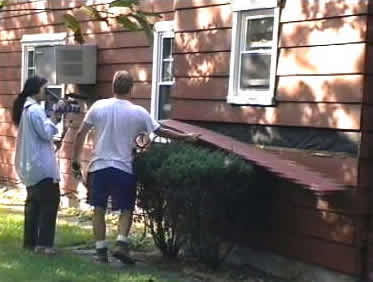
Helfand films the removal of rotten wood siding from her family home. The shot establishes her presence as a character in the film.The Blue Vinyl title shows us the completion of the new siding.

Although many documentaries explore the devastating sense of loss residents feel when their homes are lost or destroyed by everyday eco-disasters, few examine the environmental consequences of the building materials used to construct the home. Blue Vinyl (2002) and Libby, Montana (2004) move beyond lamenting eco-driven loss of the home place found in environmental documentaries from mountaintop removal films such as B. J. Gudmundsson’s Rise Up! West Virginia (2007) and Mountain Mourning (2008)[1] [open endnotes in new window] to Josh Fox’s anti-fracking expose, Gasland (2010), and unmask some of the environmental hazards of the home itself. Although their documentary approaches differ, both Blue Vinyl and Libby, Montana reveal the toxic environmental hazards faced by workers constructing housing materials and the homeowners themselves, with Blue Vinyl focusing on the dangers of Polyvinyl Chloride, and Libby, Montana highlighting asbestos and its mineral source, vermiculite.

In the personal narrative-driven Blue Vinyl: The World’s First Toxic Comedy (2002), co-director and writer Judith Helfand and co-director/cinematographer Daniel B. Gold become comic detectives in their attempt to find a viable solution to Helfand’s parents’ home repair dilemma:  Is it possible to replace rotting wood siding with “products that never hurt anyone at any point in their life cycle” but still provide the economy, endurance, and good looks of cheap but toxic blue vinyl? After attempting to convince her parents to forego their new vinyl siding choice for a more environmentally friendly alternative (as long as it’s cheap and looks good), Helfand and Gold embark on an investigative journey that reveals both the dangers underpinning vinyl use and the challenge to find a viable, affordable, and environmentally friendly alternative.

In Libby, Montana, directors Drury Gunn Carr and Doug Hawes-Davis take a more traditional documentary approach to expose the health hazards asbestos has caused in Libby’s mines and factories from 1919 until their closure in 1990. Also structured like a mystery, this social documentary combines talking head and direct cinema approaches to illuminate the biggest case of community-wide exposure to a toxic substance in U.S. history, resulting at last count in an estimated 1,500 cases of lung abnormalities. The film carefully documents the history of a town that moved from logging to mining vermiculite. Ninety-two percent of  people who worked for the mine more than twenty years died from lung disease. Most condemning is evidence that W. R. Grace & Company knew the danger of asbestos and did nothing. According to the film, despite overwhelming health problems and clear signs of criminal negligence, the EPA’s arrival in 1999 leads only to more wrangling, this time over whether or not Libby should be labeled a Superfund site.

Blue Vinyl provides a narrative of discovery in which Helfand and Gold reveal what the dangers PVC mean for not only her parents and other suburbanites keen on siding their homes with vinyl, but also for PVC chemical plant workers and home dwellers nearby.  Libby, Montana documents a mystery now solved but unresolved due to bureaucratic battles by EPA officials and corporate leaders over designating the town a Superfund site. In these eco-documentaries, multiple issues of home and homelessness are explored, revealing a plethora of environmental problems that, according to Blue Vinyl and Libby, Montana,  especially, should be addressed no matter how difficult the task. The repercussions of doing nothing are too toxic for both human and nonhuman nature. Overlooking these eco-disasters may turn the everyday into catastrophe, these films assert, reinforcing the power of an environmental justice movement grounded in an equitable and humane vision of home.

Although the documentary strategies applied in Blue Vinyl are more compelling than those in Libby, Montana these films both effectively illustrate the complexity of environmental justice issues. Environmental injustice, lack of human rights, and, to a certain extent, environmental racism intersect in the literal study of homes in Blue Vinyl and Libby, Montana. For these films’ directors, it’s not just how you live and how you build your home, it’s where you live and what’s around you that contribute to the everyday eco-disasters associated with constructing and sustaining shelter.