Saturday, January 7, 2017

Monstrous trees and ecology: targeting human threats in the horror film

Monstrous trees and ecology: targeting human threats in the horror film opening from Jump Cut


Myths from both East and West attribute the power of life to trees. Christians may decorate evergreen trees to celebrate Christmas, but these signs of the promise of spring resemble the sacred Yule Tree in Germanic mythology. In Hinduism and Buddhism, the Banyan and Peepal trees also serve as sacred trees evoking visions of eternal life. Representations of trees in literary works from Tolkien’s White Tree of Gondor in The Lord of the Rings to dryads in Rick Riordan’s Percy Jackson and the Olympians reflect this traditional beneficence of trees. This life-giving mythology of trees continues in recent animated films from Pocahontas (1995) to Avatar. In Pocahontas, Grandmother Willow provides wise advice, telling Pocahontas,
“All around you are spirits, child. They live in the earth, the water, the sky. If you listen, they will guide you.”
When she talks to John Smith, Grandmother Willow’s advice grows more direct and offers a way to encourage life over death:
“Young man, sometimes the right path is not the easiest one. Don't you see? Only when the fighting stops, can you be together.”
The Tree of Souls in Avatar (2009) looks like a willow and acts as the spiritual center of Pandora and its source for interconnection. Destroying the Tree of Souls may mean the end of Pandora and the Na’vi. Groves of trees take on the same spiritual force in Fern Gully (1992) and Princess Monononoke (1997), and as in Avatar, human exploitation threatens the forests’ life-giving energy.
Monstrous humans destroy the rainforest in Ferngully. Princess Mononoke protects the forest with help from its spirits.
Explorations of how trees transform into “monsters” seeking revenge against the human world that exploits them build on the powerful life-sustaining forces of sacred trees. The power of life attributed to trees seems like a precondition for trees being agents of wrath in resisting human degradation of the environment. The recent Zika Virus outbreak reinforces the dangers humans sometimes confront in wooded areas. With its origin in the Ugandan Zika Forest Preserve, the virus also connects trees with horrific repercussions, especially for infants and children. Although first discovered in 1947, the virus began infecting humans outside of Africa only in 2007, when it mutated to its current dangerous form. As researcher Alexander Haddow explains,
"The current Zika virus outbreak in South and Central America is another wake-up call that increased globalization and climate change will continue to lead to the emergence of viral pathogens."
According to Haddow, "We need to be preparing for the next Zika virus now" (quoted in Swails and McKenzie). In the Age of the Anthropocene, trees like these seem ready to fight back against their human oppressors.

In films as diverse as The Wizard of Oz (1939) and The Lord of the Rings: The Two Towers (2002), trees have fought back against humans, becoming “monstrous nature.” In The Wizard of Oz, trees become animated when their apples are stolen (and a wicked witch intervenes). And in the The Twin Towers, trees called Ents seek vengeance against Saruman (Christopher Lee) and his army when their leader Treebeard (John Rhys-Davies) sees a section of Fangorn Forest Saruman has decimated to feed his iron forges. Plant horror films such as Severed: Forest of the Dead (2005), The Ruins (2008), Splinter (2008), and The Happening (2008) again illustrate how trees might fight back against their human oppressors. But they also tackle contemporary environmental problems and offer biotic solutions that incorporate all the living things in an ecosystem.


Grandmother Willow tells Pocahontas to “listen to the spirits.”


Computers show the deep roots of the Tree of Souls in Avatar.


Friday, December 30, 2016

Films Viewed in 2016, the Final Entry: October, November, and December's New Coming of Age Stories


October


Honeytrap (Dir. Rebecca Johnson, 2016): In Brixton, London, fifteen-year-old Layla gets sucked into gang activity.


From Rotten Tomatoes: HONEYTRAP is the harrowing rite-of-passage drama inspired by a real-life crime of love, betrayal and murder in 2009. Featuring an international cast, the movie stars Jessica Sula (Skins, ABC Family's Recovery Road) Lucien Laviscount (Fox's Scream Queens), Naomi Ryan (GUARDIANS OF THE GALAXY) and Ntonga Mwanza (LEAVE TO REMAIN). Girlhood and gang culture collide in HONEYTRAP as 15-year old Layla (Sula) contends with bullying at a new school by transforming herself inside and out. The teen's compulsive journey for love and acceptance soon becomes fatal in this cautionary tale based on headline news adapted by writer/director Rebecca Johnson.


The Confirmation (Dir. Bob Nelson, 2016): A divorced father (Clive Owen) and his eight-year-old son (Spencer Drever) spend a rather predictable weekend together, but when a valuable toolbox gets stolen, the search for the thieves will turn into a true family bonding.


Mark Dujsik from RogerEbert.com: “This is a smart, effective coming-of-age tale about a boy figuring out that there are gray areas to life's moral choices.” 

November


Morris From America (Dir. Chad Hartigan, 2016): The romantic and coming-of-age misadventures of a 13-year-old American living in Germany. 


From Rotten Tomatoes: Critics Consensus: Morris from America adds some novel narrative twists to its father-son story -- and gains added resonance thanks to a powerful performance from Craig Robinson.

December


Moonlight (Dir. Barry Jenkins, 2016): A timeless story of human self-discovery and connection, Moonlight chronicles the life of a young black man from childhood to adulthood as he struggles to find his place in the world while growing up in a rough neighborhood of Miami.


From Rotten Tomatoes: Critics Consensus: Moonlight uses one man's story to offer a remarkable and brilliantly crafted look at lives too rarely seen in cinema.


Sunday, December 25, 2016

Films Viewed in 2016, cont.: July, August, and September and Women Empowered

Cutie and the Boxer (Dir. Heinzerling, 2013)


This candid New York love story explores the chaotic 40-year marriage of famed boxing painter Ushio Shinohara and his wife, Noriko. Anxious to shed her role as her overbearing husband's assistant, Noriko finds an identity of her own.


On its simplest level, “Cutie and the Boxer” is a documentary about a couple who could be sort of the Bickersons of the art world. Lurking just beneath, however, is a painful, powerful portrait of the struggle and sacrifice required to create, and the cost that it can demand. (Bill Goodykoonz, The Atlantic)


Mustang (Dir.  Deniz Gamze Ergüven, 2015)  


Early summer. In a village in northern Turkey, Lale and her four sisters are walking home from school, playing innocently with some boys. The immorality of their play sets off a scandal that has unexpected consequences. The family home is progressively transformed into a prison; instruction in homemaking replaces school and marriages start being arranged. The five sisters who share a common passion for freedom, find ways of getting around the constraints imposed on them.


Mustang tells a straightforward story of female empowerment, but it’s the way it tells that story that makes it deserving of all the accolades it’s received, including an Oscar nomination for best foreign-language film. Though the movie has won (superficial) comparisons to The Virgin Suicides, it has a more distinctly female perspective and is too close to its subjects to feel voyeuristic. The trouble begins in the first 10 minutes of the film, when some nasty gossip and a misunderstanding turns innocent fun into a minor sexual scandal, leading the girls’ relatives to increasingly shut down their access to the outside world. The Turkish-born French director Deniz Gamze Ergüven balances out the film’s creeping claustrophobia with quiet (and not-so-quiet) acts of rebellion, unexpected humor, and warmth, and the result is a tender and fresh coming-of-age film that honors the bonds of womanhood and sisterhood without taking them for granted. (Lenika Cruz, The Atlantic)


Margarita with a Straw (Dir.  Shonali Bose, Nilesh Maniyar, 2014)


A rebellious young woman with cerebral palsy leaves her home in India to study in New York, unexpectedly falls in love, and embarks on an exhilarating journey of self-discovery.  


“Margarita, With a Straw” is one of the least hand-wringing movies ever made about a character with significant disabilities. Born with cerebral palsy, our heroine here certainly has her physical limitations and related psychological setbacks, but it’s her adventurous spirit (abetted by supportive family and friends) that sets the tone in Shonali Bose’s winning sophomore feature. Like her first, 2005’s “Amu,” this tale is rather Westernized in the telling, with narrative feet planted in both India and the U.S. That factor, good reviews and the pic’s crowdpleasing nature should guide it from a successful festival run to various format sales in numerous offshore territories, with niche theatrical sleeper status possible. (Dennis Harvey, Variety


Saturday, December 24, 2016

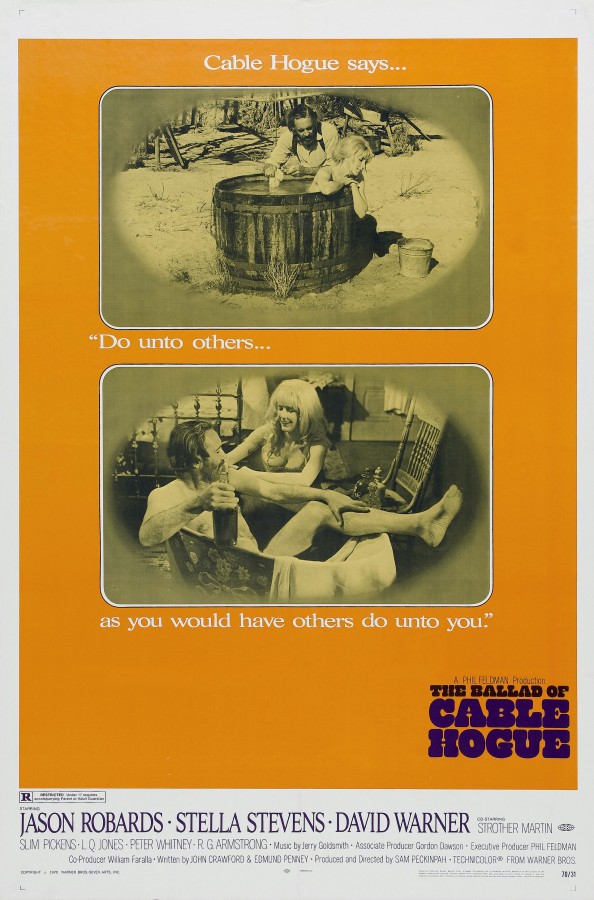
Our First Autry Museum of the West Presentation: The Ballad of Cable Hogue (1970)


The Ballad of Cable Hogue
The Autry Museum of the West

January 2017, What Is a Western? Film Series:
The Ballad of Cable Hogue (1970)
 
Part of the series What is a Western? Film Series

Saturday, January 21, 2017, 1:30 p.m.

The Autry: Wells Fargo Theater
Admission: 
Included With Museum Admission / Free for Autry Members
RSVP/Reservations: 
Space Is Limited / Reservations Recommended
RESERVATIONS

About the Event

Selected by guest curators Robin Murray and Joseph Heumann, the January/February films consider the importance of water in the arid West. Murray and Heumann are the authors of Gunfight at the Eco-Corral: Western Cinema and the Environment and a number of other studies of ecocinema.
In The Ballad of Cable Hogue, its “little guy” protagonist, Cable Hogue (Jason Robards), stands for democratic views of progress but still exploits the natural world. As a working-class miner, Cable also uses water rights policies to build himself a small empire. Because Cable builds his business by exploiting natural resources, he also helps construct a modern world where technology takes his place. Rated R.

Directed by Sam Peckinpah  | Starring Jason Robards, Stella Stevens, and David Warner
Screened in 35 mm
The Ballad of Cable Hogue
The Ballad of Cable Hogue (1970)
The Ballad of Cable Hogue
The Ballad of Cable Hogue (1970)

Saturday, December 17, 2016

Eco-Films on Different Platforms: April, May, and June 2016 Screenings

April


Blockbuster: The Martian (dir. Ridley Scott, 2015)

Despite a narrative focused on bringing astronaut Mark Watney (Matt Damon) home from Mars, The Martian places ecology at its center. As Watney explains in a video blog entry in the film, "In the face of overwhelming odds, I'm left with only one option: I'm gonna have to science the shit out of this." Because of this focus on scientific solutions, The Martian is the best example of ecocinema I've seen in the theatre this year. As an expert botanist, Watney draws on his knowledge of the natural world in order to survive on what seems like a lifeless planet. Watney even declares, "Mars will come to fear my botany powers." Watney recognizes the need to draw on nature rather than technology for survival and constructs a livable space using natural elements and bi-products instead of artificial (and perhaps toxic) chemicals.


Independent Documentary:  
The Garden (dir. Scott Hamilton Kennedy, 2008)

The contemporary South Central Los Angeles urban farm explored in Scott Hamilton Kennedy’s Oscar-nominated documentary The Garden (2008) encourages sustainable practices, but as scholars have lauded, the documentary also engages effective narrative strategies and presents powerful messages regarding environmental injustice and racism. With its condemnation of environmental racist attitudes of Los Angeles council members and activists, The Garden spends the time to document the history of the fourteen-acre urban farm and illustrate its benefits to South Central LA community members. The garden provides not only food and communal income. It also serves as a sacred space in which community members gain self-worth as they commune with the plants they grow 

May


Disney's Live Action Remake:  
The Jungle Book (dir. Jon Favreau, 2016)

In this reimagining of the classic collection of stories by Rudyard Kipling, director Jon Favreau uses visually stunning CGI to create the community of animals surrounding Mowgli (Neel Sethi), a human boy adopted by a pack of wolves. The appearance of a villainous tiger named Shere Khan (voiced byIdris Elba) forces Mowgli's guardian, the panther Bagheera (Ben Kingsley), to shepherd the child to safety in the "man village." Along the way, the boy meets an affable, lazy bear named Baloo (Bill Murray), as well as a snake with hypnotic powers (Scarlett Johansson) and an orangutan (Christopher Walken) who wants to harness the power of fire. Lupita Nyong'o, Giancarlo Esposito, and Garry Shandling also lend their voices to this adventure tale.

Critics Consensus from Rotten Tomatoes: As lovely to behold as it is engrossing to watch, The Jungle Book is the rare remake that actually improves upon its predecessors -- all while setting a new standard for CGI.


June

YouTube Sensation: Under the Dome (dir. Chai Jing, 2015)


Jing Chai’s Internet sensation Under the Dome is universally heralded by reviewers in the U.S. and Europe. Each reviewer first notes how the online sensational feature-length “Ted”-like talk drew more than 200 million views from Chinese audiences in the few days before being taken down by Chinese government censors. But as Steven Mufson of The Washington Post notes, the documentary also “alters the way we see the world around us.” As a high-tech Silent Spring, Under the Dome applies a rhetoric and structure similar to that of Davis Guggenheim and Al Gore’s an An Inconvenient Truth (2006) with one major difference, its exclusive focus on pollution in the cities of Mainland China.
 

Tuesday, December 6, 2016

Selected "Overlooked" Films and Videos Viewed in 2016: Coming of Age, January-March

January:

Dope (dir.   2015). Stars,  ,  ,   


From Rotten TomatoesA critical hit and audience favorite out of the Sundance Film Festival, in DOPE, Malcolm (Shameik Moore) is carefully surviving life in a tough neighborhood in Los Angeles while juggling college applications, academic interviews, and the SAT. A chance invitation to an underground party leads him into an adventure that could allow him to go from being a geek, to being dope, to ultimately being himself. (C) Open Road


February:

Big Hero 6 (dir. ,   2014). Stars: ,  ,  


From Rotten Tomatoes: With all the heart and humor audiences expect from Walt Disney Animation Studios, "Big Hero 6" is an action-packed comedy-adventure about robotics prodigy Hiro Hamada, who learns to harness his genius-thanks to his brilliant brother Tadashi and their like-minded friends: adrenaline junkie Go Go Tamago, neatnik Wasabi, chemistry whiz Honey Lemon and fanboy Fred. When a devastating turn of events catapults them into the midst of a dangerous plot unfolding in the streets of San Fransokyo, Hiro turns to his closest companion-a robot named Baymax-and transforms the group into a band of high-tech heroes determined to solve the mystery. (C) Disney


March:

Diary of a Teenage Girl (dir.  2015). Stars: ,  ,  


From Rotten Tomatoes: Like most teenage girls, Minnie Goetze (Bel Powley) is longing for love, acceptance and a sense of purpose in the world. Minnie begins a complex love affair with her mother's (Kristen Wiig) boyfriend, "the handsomest man in the world," Monroe Rutherford (Alexander Skarsgård). What follows is a sharp, funny and provocative account of one girl's sexual and artistic awakening, without judgment. (C) Sony Classics


Saturday, November 19, 2016

Tree Horror and Irresponsible Science: The Earth Bites Back in Severed: Forest of the Dead


Severed: Forest of the Dead addresses the dangers of genetic experimentation, but it also highlights the need for communal action and a biotic community to overcome its repercussions. Overhead shots of a massive dense forest establish the setting and introduce the film’s first conflict between environmental activists and loggers. Shots of protesting activists are juxtaposed with footage of loggers cutting down and preparing timber, illustrating the whole lumbering process from forest to truck to processing. Activists chain themselves to trees while loggers work. A banner shows us that these young environmentalists represent the Forest Action Committee. Their signs declare, “Greed will not clean our air” and argue against depleting natural resources. They shout at the loggers, “get out of our forest!” Trailer


Mac, the logger boss (Julian Christopher) at first confronts the environmentalists, warning his men to be careful because the protesters are too close. But he also opposes the company bosses for whom he works. When he sees two company research scientists taking samples from an enormous tree, he tells them to come down for “less talk and more chop.” One of these researchers, Carter (J.R. Bourne), notices extra thick sap and announces, “Something isn’t right… I’ve never seen this volume of sap before,” but he tells Mac there’s no cause for alarm instead of revealing its source: the company is testing GX1144, a new GMO product the company believes will accelerate growth and increase yields.

Tree horror is the result of these genetic experiments. When a logger cuts down the altered tree, the remaining trunk is covered with red sap that flows down its bark like blood. It oozes as the logger saws through the trunk. Activists have spiked the tree in protest. The chain saw hits the spike, sending it flying back. It slashes the logger. Mac calls for help, but the logger begins convulsing. His eyes turn red. He begins to growl and grab at the other loggers. He has turned into a viral zombie, a “natural” eco-zombie, according to S. J. Lauro (2011). For Lauro, the eco-zombie in Severed “incarnates anxieties regarding the abuses of the planet by capitalist industry” (pg. 61). The next scene confirms Lauro’s claim. Lumber company corporate officers and board members discuss the success of GX1144. It has increased profits by 15%. Their goal is to expand the testing area for the genetically altered lumber until a secretary shares bad news about the logging camp. They have lost contact with the camp and blame the Forest Action Committee, led by Rita Hoffman (Sarah Lind). The logging camp is in the testing area, and if Hoffman finds out, it might draw undue attention to their GX1144 program. 

 To address the board’s concerns, its members send the CEO’s son Tyler (Paul Campbell) to the camp. Although representing the enemy, Tyler ultimately becomes part of a biotic community that also includes loggers and environmentalists. His entrance in the camp also shows us what happens when we disturb the natural order: monsters. When Tyler drives his truck off the ferry, the logging camp is deserted and in shambles. Undead loggers feed on corpses, but Tyler escapes into a forest and hides in a shed with unscathed logger Luke (Michael Teigen), environmental activist Rita, logging boss Mac and company man Carter. Rita tells Tyler he has been “raping the earth” and the GMO-induced infection supports her claim. This secret GX1144 testing area must be quarantined to maintain stock prices, and their survival depends on collectively battling monstrous results of bad science. 

The rest of the narrative focuses on the clashes with zombies that the loggers and environmental activists must face together. Rita, Tyler, and Mac form an unlikely alliance that shows the power of community. Carter is the weak link in their group, and ultimately nearly kills them all because he refuses to cooperate. He and the logging corporation usurp the power of the new community. The group’s first attempt to escape is thwarted by the company men who block the bridge to town and through Carter’s unwillingness to share blame. Carter reveals the problems with GX1144 only after Mac threatens him, arguing that he is the only one “who can end clear-cut logging.” Carter and the company men also halt the group’s second attempts to escape through a second logging camp. Company thugs shoot at the group from helicopters. Other loggers capture and hood them, taking them back to their camp. Led by Anderson (Patrick Gallagher), these loggers have created a more hostile community than Mac’s. They threaten Rita and target zombies daily, ritually killing them in a carefully constructed gladiator arena. Carter sneaks away from the compound and deliberately leaves the gates to the prison open, so the remaining zombies attack, killing Mac, Carter, and Tyler. Rita escapes, reaching a road. The last shot shows Tyler’s heartless father in his enormous mansion toasting his dead son. 

Ultimately the message of this campy film makes legitimate claims. First of all, messing with nature through genetic experimentation can be dangerous. Although the science behind these genetically modified trees is highly exaggerated, it is based in fact. Botanists agree these genetically modified “transgenic” trees have the potential to both benefit and devastate the environment. In a University of British Columbia Terry Project report (2015) http://www.terry.ubc.ca/files/PBL/GMPBL3.pdf, proponents argue, “Tree genomics has the potential to considerably improve the planting stock by reproducing desirable traits such as resistance to insects, extreme climates and herbicide or increasing the wood quantity and quality,” especially in the Anthropocene Age This same report also notes concerns, asserting that transgenic trees may propagate gene flow and Superweeds:
“Gene flow could create considerable species displacement and ecosystem disruption”


The report supports these concerns with examples from experimental plantings in China (Terry Project, 2015). In a briefing paper issued by the Global Justice Ecology Project (2015), Dr. D. Suzuki agrees, declaring transgenic trees have
“the potential to transfer pollen for hundreds of miles carrying genes for traits including insect resistance, herbicide resistance, sterility and reduced lignin [supportive structural plant materials].”
These transgenic trees “have the potential to wreak ecological havoc throughout the world’s national forests.” Transgenic trees may not produce zombies, but they may “increase human exposure to hazardous chemicals” (Global Justice, 2015). Severed may illustrate an extreme consequence of planting transgenic trees, but its horror themes are based in science.


If a GMO tree crisis occurs, however, the solution is communal rather than individual. Carter and the company are clearly painted as enemies in the film, as greedy exploiters of both human and nonhuman nature. Rita is also culpable in the infestation, since she and her environmental group spiked the tree that infected the logger. Because she alone survives, however, the film suggests her crimes are minor compared to those of Carter and the company men who would let even their own children die. Ultimately, environmentalists must team up with at least some loggers to overcome the corrupt company battling them both.